
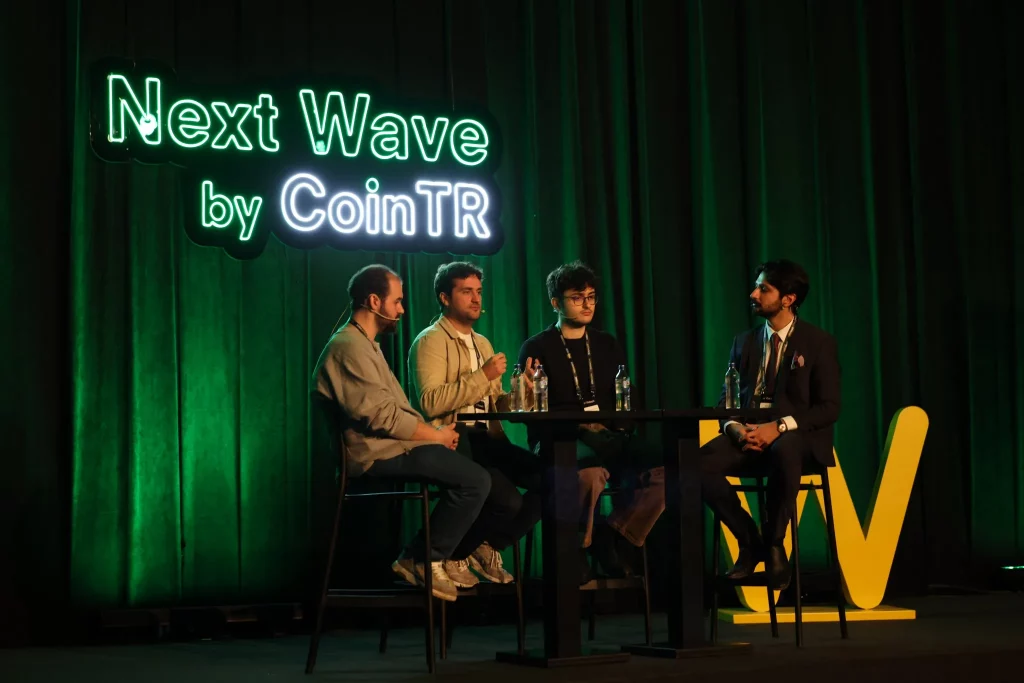
At Webrazzi Fintech 2024, on the panel “Pioneering Startups Shaping the Future of Web3 in Türkiye,” Vircon Legal Managing Partner Erdem Mümtaz Hacıpaşaoğlu took the stage with Burak Çevik (Founder & CEO, Gameness), Esad Yusuf Atik (Co-founder & CTO, Chainway) and Ömer Kaya (Co-founder & CTO, FirstBatch).
The structural questions a Web3 company answers before it ships
Web3 teams tend to arrive at counsel with a product question and leave with a structuring one. The reason is that three decisions — where the entity sits, whether value accrues to equity or to a token, and which side of the licensing perimeter the product falls on — are made once, early, and are expensive to unwind. A team that ships first and structures later usually pays for it at its first institutional round, when the diligence file has to explain why the token was issued by an entity that does not own the code.
Token or equity: they are not interchangeable
The first fork is whether the network needs a token at all. Where it does, the token and the cap table are two separate instruments with two separate legal regimes, and investors increasingly want exposure to both — hence the token warrant or side letter sitting alongside a SAFE. Getting the allocation right matters more than the headline supply figure: founder and team allocations, vesting and cliff, treasury, and what the tokenomics commit the company to doing in public.
The classification question follows. A utility token that genuinely functions as access to a live network is a different legal object from a security token marketed on an expectation of profit from the efforts of others — the analysis the Howey test formalises in the United States and which shapes how sophisticated teams write their own materials everywhere. Marketing copy is evidence. A deck promising appreciation is harder to reconcile with a utility characterisation than any whitepaper paragraph can fix afterwards.
Where the regulated perimeter begins
Most Web3 products are unregulated until they touch custody, exchange, or fiat. The moment a product holds a user’s keys, matches orders, or moves value between fiat and crypto, it is likely inside a licensing regime and inside anti-money laundering obligations — including customer identification and the travel rule for transfers. In Türkiye that perimeter is defined around crypto-asset service providers; our walkthrough of the application process is in The CASP Licence in Türkiye, and the practice page is CASP / Crypto Compliance.
A non-custodial architecture is not a loophole, but it is a design choice with legal consequences worth making deliberately rather than discovering later.
Cross-border reality
Turkish Web3 teams almost always end up multi-jurisdictional: a development company in Türkiye, a holding or foundation elsewhere, users everywhere. That structure is defensible when it is built for a reason and documented — intercompany agreements, IP assigned to the right entity, transfer pricing that reflects where value is actually created. It is indefensible when it exists only on a slide. See Why Founders Flip Up for how the same logic plays out in the wider startup context.
Go deeper
- Crypto Assets, Web3 & Regulated Digital Markets
- Private Investment Vehicles: SAFEs vs. SAFTs
- Founder & Investor Legal Glossary
Author

More from Vircon Insights
Building the Future by Binance TR at Webrazzi Fintech 2025
December 10, 2025OKX Türkiye Live Broadcast: Travel Rule in Turkey
February 27, 2025Legal Aspects of Web3 Nowadays: DeGameFi Tbilisi Panel
August 7, 20242024 Web3 Legal Trends: Qatar Websummit Workshop
June 3, 2024Crypto-Asset Regulation in Türkiye: ETH Günü at Devconnect
November 13, 2023Doing Business in USA: YTILI Alumni Board Panel
September 3, 2025Related Practice Areas
ICOs, Crypto & Blockchain
Crypto-asset regulation, token offerings, exchange and custody licensing.
View service →Startup Law
Incorporation, founder agreements, ESOP, term sheets, regulatory matters.
View service →US Company Formations & Flip-Ups
Delaware C-Corp, flip-up structures, SAFE/convertible notes, 83(b).
View service →