
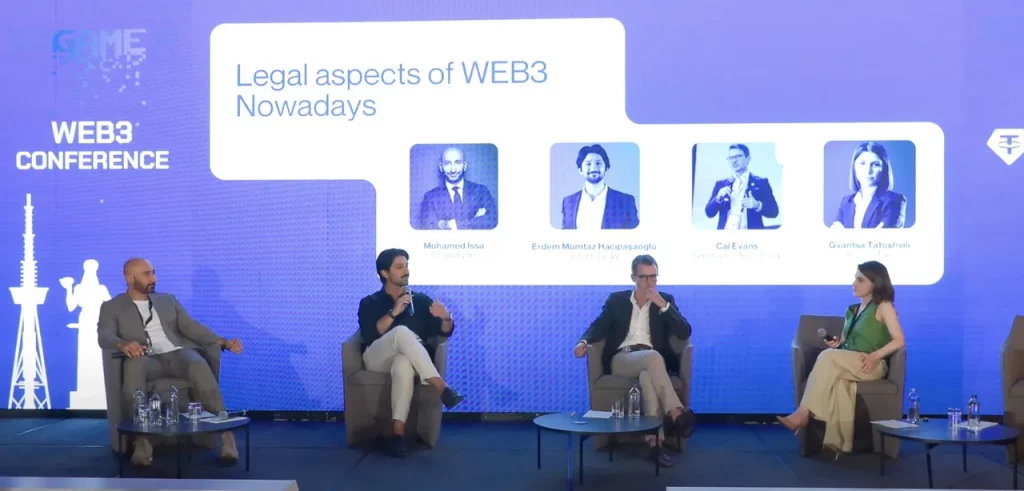
In August 2024, the “Legal Aspects of Web3 Nowadays” panel held at the DeGameFi conference in Tbilisi, Georgia, examined how Web3 law is being shaped today through the perspective of three lawyers operating across different jurisdictions. Our Managing Partner Erdem Mümtaz Hacıpaşaoğlu joined the panel as a speaker.
The central thesis of the panel was clear: the international nature of Web3 makes it impossible to fit the legal framework into a single jurisdiction; engaging with regulators early, and educationally: is the only sustainable way to manage the gray areas.
Panelists and moderation
The panel speakers were Vircon Legal Managing Partner Erdem Mümtaz Hacıpaşaoğlu, digital asset lawyer Cal Evans, and Chainalysis Regional Sales Strategist Mohamed Issa. The session was moderated by Gvantsa Tatoshvili of IBCCS Tax.
Challenges of international legal frameworks
Mohamed Issa flagged the practical difficulties created by the misalignment of regulatory frameworks across jurisdictions and underlined the critical importance of educating law enforcement and regulators; he described how Chainalysis collaborates globally to make blockchain analysis usable in the fight against illicit activity. Erdem Mümtaz Hacıpaşaoğlu, in turn, explained why constant updateability and adaptability are so decisive in Web3 legal frameworks: framed around the management of gray areas.
Jurisdictional arbitrage and the regulator relationship
Cal Evans highlighted the strength of jurisdictional arbitrage in the Web3 industry and stressed the strategic importance of companies educating regulators and building long-term relationships with them; he underlined that the rapid evolution of the industry continually outpaces regulatory frameworks. Mümtaz added that different regulations can be both a “curse” and a “blessing”; the real question is striking the balance between safety and flexibility.
Relationship with traditional banking
Issa argued that for crypto to integrate with traditional banking, the proper implementation of AML, KYC and KYT procedures is critical, and is the path to building trust with banks. Mümtaz addressed Turkey’s upcoming regulations and the role banks will play in the crypto ecosystem, sharing his expectation that DeFi will take a more prominent place in the future. Cal Evans framed the social-responsibility dimension of KYC/AML through Bitcoin’s foundational principles and the importance of users retaining control over their own assets.
The future: legal tech, AI and partial KYC
The panelists emphasized the strategic value of consulting lawyers early in the project lifecycle, the need for scalability in legal frameworks, and the importance of proactive dialogue with regulators. Mümtaz pointed to the future potential of legal tech and AI in assisting regulatory compliance. In the Q&A, privacy coins and partial KYC solutions built on zero-knowledge proofs were discussed as tools that will shape the future balance between privacy and compliance.
Highlights from this issue
- International frameworks: Continuous updateability and gray-area management
- Jurisdictional arbitrage: Building educational relationships with regulators
- Bank relationships: AML, KYC, KYT procedures and trust-building
- Future tooling: Legal tech, AI and zero-knowledge-proof-based partial KYC
Panel video
You can read the original Substack publication at Understanding Web3 Legal Implications: Issue 13.
Author

More from Vircon Insights
2024 Web3 Legal Trends: Qatar Websummit Workshop
June 3, 2024Doing Business in USA: YTILI Alumni Board Panel
September 3, 2025Pioneering Startups Shaping the Future of Web3 in Türkiye: Webrazzi Fintech 2024
December 11, 2024Web Summit Qatar 2024 Keynote: Clemta's SaaS Transformation and Blockchain Legal Infrastructure
February 29, 2024Building the Future by Binance TR at Webrazzi Fintech 2025
December 10, 2025Fintelogy Crypto-Asset Law and Compliance Management Certificate Program
March 20, 2025Related Practice Areas
ICOs, Crypto & Blockchain
Crypto-asset regulation, token offerings, exchange and custody licensing.
View service →US Company Formations & Flip-Ups
Delaware C-Corp, flip-up structures, SAFE/convertible notes, 83(b).
View service →Privacy & Cybersecurity
KVKK and GDPR compliance, breach response, cybersecurity governance.
View service →