
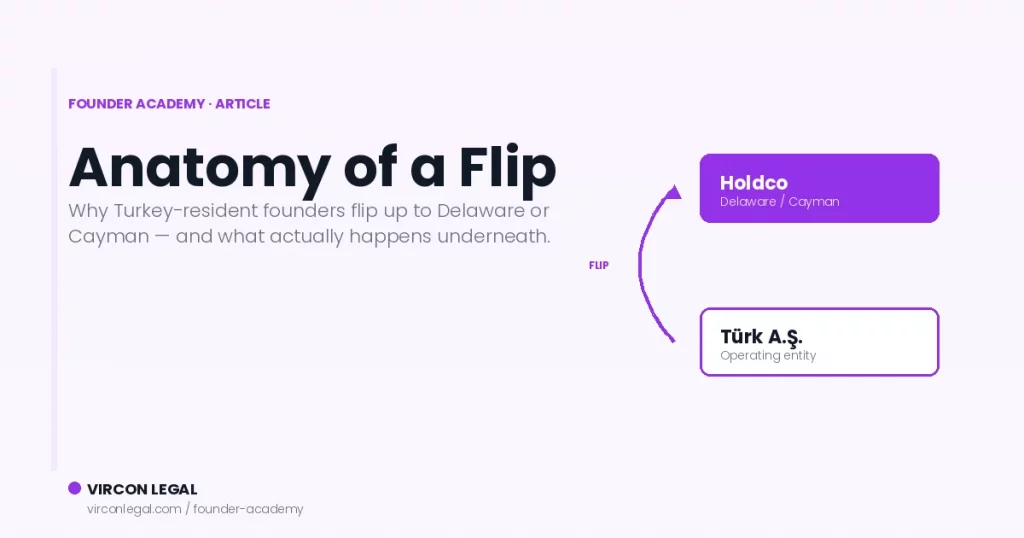
Almost every Turkey-resident startup founder ends up at the same dinner conversation. Someone (an investor, an advisor, another founder a year ahead) says the word flip, and suddenly a structural decision is sitting in the middle of the table. Most founders don’t fully see what flipping up actually means. They’ve heard “Delaware C-corp” or “Cayman holding” enough times to nod along, but the moves underneath those phrases keep compounding across tax, governance, and operations for years afterward. This is what’s actually happening when a company flips.
Why founders flip
At root, founders flip because the system on the other side of the flip is built for them and the system on this side isn’t. Six things make that true.
Start with capital access. US venture firms (the Tier-1 funds, Y Combinator, 500 Global, Techstars) are calibrated end to end for Delaware C-corps. Their LPAs assume it, their investment-committee templates assume it, their lawyers know exactly what to do with it. Asking a US fund to invest into a Turkish anonim şirket means asking it to absorb structuring cost it doesn’t normally pay, and that cost comes back to the founder as a valuation discount or a tighter set of terms, when the fund engages at all. European funds run the same arithmetic with respect to Cayman or UK Ltd holdings. For Europe-led rounds, Cayman has become the quiet default neutral jurisdiction.
The financing instruments compound the same pressure. The entire post-2013 stack: YC’s SAFE, the NVCA model documents for priced rounds, 500 Global’s KISS: assumes a Delaware C-corp issuer. Adapting them to Turkish corporate law is possible; we do it routinely. But every round adds legal cost and term-sheet friction the founder eventually decides isn’t worth paying twice.
Then there’s the exit. Strategic acquirers, particularly US and EU strategics, default to buying Delaware or Cayman entities. The diligence runs faster, the SPA is templated, the regulatory analysis is bounded. Buying a Turkish anonim şirket instead triggers Turkish merger-control filings, Treasury approvals on FX outflows, and parallel post-closing reorganizations. Acquirers internalize all of that as a discount, typically 10 to 25 percent. The IPO calculus is even sharper: NASDAQ, NYSE and the LSE have well-trodden processes for Delaware and Cayman issuers and ad hoc processes for emerging-market private companies.
Talent equity follows the same logic. Top global engineering and product hires expect ISOs, NSOs, or RSUs under a US plan, with 83(b) elections, double-trigger acceleration, and a 90-day post-termination exercise window. None of that exists in Turkish corporate practice. Candidates who’ve worked at US-listed companies discount equity grants from non-US issuers because the post-exit tax and liquidity outcomes are unpredictable, and increasingly, candidates who haven’t worked there do too. Flipping lets you offer something they recognize.
Modern banking infrastructure is wired the same way. Stripe, Mercury, Brex, Wise Business: all of it defaults to US-incorporated entities. A Turkish anonim şirket struggles to open a Mercury account, faces 60-day delays on Stripe, and pays material FX on every payout cycle. A Delaware C-corp opens Mercury or Brex in under a week and settles USD revenue same-day.
Underneath all of this sits trust. Enterprise customers in regulated industries (healthcare, financial services, government) score foreign suppliers harshly on vendor onboarding. Delaware C-corps pass faster. Delaware Chancery and the English commercial courts offer predictable IP and contract-enforcement infrastructure that just doesn’t exist for cross-border claims involving Turkey-only entities. Take all six pressures together and the gravitational pull is hard to resist.
The anatomy of a flip
From the outside, the flip looks like one transaction: form a new holding, exchange the shares, done. From the inside, it’s a sequenced series of moves that have to be coordinated tightly enough that eight separate pieces fit together without breaking anything. The cleanest flips run about 6 to 12 weeks.
You start by incorporating the holding company in the target jurisdiction: almost always a Delaware C-corp for US-led rounds, an exempted Cayman company or occasionally a UK Ltd for Europe or APAC exposure. Articles, bylaws, founder share issuance, board adoption, all done before anyone touches the Turkish entity.
How the flip is executed matters. Will the SHA be translated, the rights adapted one-for-one to Turkish law, or will the flip happen under NVCA model documents for the US market? That choice deserves deliberate selection.
Then comes the share exchange. The existing Turkish shareholders (founders, angels, employees with vested equity) swap their Turkish shares for new holdco shares at a ratio matching the existing cap table. Economic ownership stays identical; only the issuer changes. The exchange is documented through a multi-party Share Exchange Agreement governed by either Delaware or English law. Each transaction is its own animal. Swapping shares one-for-one does not by itself guarantee a tax-neutral outcome. Each phase needs careful examination to construct the right tax architecture.
Once the exchange closes, the Turkish anonim şirket becomes a wholly-owned subsidiary of the holdco. Governance, employees, contracts, operations all keep running uninterrupted. To the outside world (customers, vendors, regulators), nothing has changed. To insiders, the issuer of value is now the holdco.
The IP decision sits next, and it’s the most consequential single move in the sequence. Where the IP lives shapes every subsequent decision on transfer pricing, exit structuring, and ongoing tax exposure. Three patterns dominate. Some companies transfer IP fully to the holdco and license it back to the Turkish entity: cleanest for exit, but it creates the largest immediate Turkish tax exposure, since IP assignment is taxed at fair market value and FMV at the flip point is whatever investors are pricing the company at. Others keep IP ownership in the Turkish entity and license it exclusively to the holdco at an arm’s-length royalty: minimizes immediate tax but complicates exit because a strategic acquirer wants the IP-owning entity, which means a second restructuring at exit. A third bifurcated model splits the IP: code and trademarks to the holdco, customer contracts and data with the Turkish entity. We see this used when GDPR or KVKK constraints make the customer-data side difficult to move. In limited cases, a fourth option emerges where we fold the IP itself, as a monetary value, into the share exchange.
Employment and equity then get restructured around the new structure. Founders typically receive holdco restricted stock with new vesting, often with partial credit for time served at the Turkish entity. Senior employees may receive parallel ISO or NSO grants from the holdco: particularly common when those employees aren’t Turkey-resident. Turkey-resident talent often stays employed by the Turkish entity but receives holdco equity grants. Each pattern has its own tax mechanics. The one that catches founders out most often is the US 83(b) election: it has to be filed within 30 days of restricted stock issuance, and missing the deadline is irreversible.
After that, capital flows reorganize. Future investment rounds will flow into the holdco, which then capitalizes the Turkish operating entity through equity contributions, debt, or service agreements. Whichever route you pick, transfer pricing analysis becomes mandatory: charges between holdco and Turkish entity have to be arm’s length, and the Turkish Revenue Administration audits these flows aggressively for startups that have flipped.
Then comes the regulatory cleanup. MERSİS update for the change of control, VERBİS refresh under KVKK Article 16, regulator notifications for any sectoral licenses: BDDK, SPK, MASAK, depending on the industry, and refreshed transfer pricing documentation. The holdco enters US tax compliance (Delaware franchise tax, federal corporate income tax) or Cayman compliance. For founders, Section 367(a) of the US Internal Revenue Code can trigger phantom US tax on the share exchange. Careful structuring avoids it, but the analysis is mandatory.
Eventually the operational cadence shifts. Board meetings move to the holdco level, and the Turkish entity’s board becomes a quarterly governance function. Financial reporting consolidates at the holdco. Auditors coordinate at year-end, typically a US-affiliated Big Four affiliate plus a Turkish auditor. It takes two or three quarters before the new rhythm feels natural.
When not to flip
The flip is a structural commitment, and it compounds against you if the underlying premise is wrong. We’ve seen three contexts where founders flipped and regretted it. The first is local-market-only businesses: if the company serves Turkish customers only with no realistic international expansion path, the flip adds compliance overhead with no offsetting upside, and the Turkish entity alone is the right structure. The second is pre-product-market-fit: flipping before you have a repeatable revenue model adds structural complexity exactly when you most need optionality, and the cleaner answer is to wait until Series A is on the table. The third is significant existing revenue without prior tax planning: if the Turkish entity already has $5M in ARR and accumulated profits, the share exchange creates real Turkish tax exposure that may exceed the round proceeds. The KVK Articles 19 and 20 tax-deferred pathways require advance structuring; bolt-on tax engineering at the moment of flip rarely works.
Timing
The cheapest, cleanest, lowest-tax-exposure flip is the one that happens at incorporation: incorporate the Cayman holdco first, with the Turkish entity as a wholly-owned subsidiary from day one. We’re seeing more founders structure intentionally this way when they know from the start they’ll raise US capital. For founders who started Turkish-first and need to flip later, pre-Seed and Seed flips are still routine and inexpensive. Series A flips are doable but more expensive and require careful tax structuring. Post-Series A flips with material revenue can run into the millions and may not be economically justified at all.
What to do before deciding
The flip decision is structural rather than procedural. Before signing a term sheet that assumes a flip, walk through our 15-item Flip-Up Decision Checklist. It steps through strategic fit, market exposure, tax position, cap-table readiness, and timing: with a decision matrix that scores readiness across each dimension. If any one section comes up weak, you’ll know exactly which conversation needs to happen first.
US Flip-Up Decision Checklist
15-item decision checklist: strategic fit, market exposure, tax position, cap-table readiness, and timing. With a decision matrix that scores readiness across each dimension.
Legal notice. This article offers general information about flip-up structures and is not legal, tax, or financial advice. The Turkish Corporate Income Tax provisions, US Internal Revenue Code sections, and corporate-law mechanisms referenced are general references; applying them to your company requires evaluation by a lawyer and tax advisor experienced in cross-border startup structuring. Vircon Legal: [email protected]
Flip drivers vs. what each one actually requires
| Stated driver | What it really requires | Flip actually needed? |
|---|---|---|
| “Our lead investor requires Delaware” | Familiar instruments (SAFE, NVCA docs) and enforcement comfort | Usually yes: fund mandates rarely bend |
| US customers / enterprise sales | A US contracting entity and bank account | Often a subsidiary suffices: cheaper than a flip |
| ESOP that hires globally | Option-friendly corporate law | Partly: mirrored plans work, but at complexity cost |
| Exit optics for a US acquirer | Clean single cap table under familiar law | Yes at scale; premature before real M&A interest |
| “Everyone in our batch did it” | Nothing | No: a flip is a tax and cost event, not a status symbol |
When is a flip clearly premature?
Before a committed lead requires it: you pay the legal, tax and dual-entity running costs now, for a benefit that only crystallises at the round. The right sequencing is a term sheet conditioned on the flip, executed together.
Is a reverse flip realistic later?
It exists: Turkish incentives and domestic exits sometimes pull structures back, but unwinding is costlier than the flip itself; see our reverse flip-up explainer before treating the move as reversible.
This week’s homework
Find your row in the table. If your driver is row two or five, price a US subsidiary this week before pricing a flip: the comparison memo is two pages and can save six figures.
Sources. Law No. 6698 on the Protection of Personal Data (KVKK). Statute links open the official consolidated Turkish texts on mevzuat.gov.tr.
Author

More from Vircon Insights
Anatomy of a Game Publishing Agreement Under Turkish Law: Revenue Share, Recoupment, Minimum Guarantee and Who Keeps the IP
October 19, 2026The Turkish Equivalent Of…: A US–Türkiye Corporate Law Concordance for Founders, Investors and Counsel
October 9, 2026Group Companies After the Flip-Up: Control, the Dependency Report and Loss Compensation Under TCC 195–209
October 8, 2026Raising Your First Round as a New Game Studio: The Chain of Title Problem When the Founders Still Work Elsewhere
September 30, 2026Director Liability in a Turkish Joint-Stock Company: Founders, Investor Nominees and Articles 553–560
September 28, 2026Getting the IP Out of Founders' and Employees' Heads and Into the Company
September 22, 2026Related Practice Areas
US Company Formations & Flip-Ups
Delaware C-Corp, flip-up structures, SAFE/convertible notes, 83(b).
View service →Corporate Law
Share transfers, capital increases, board structuring, governance.
View service →Startup Law
Incorporation, founder agreements, ESOP, term sheets, regulatory matters.
View service →