
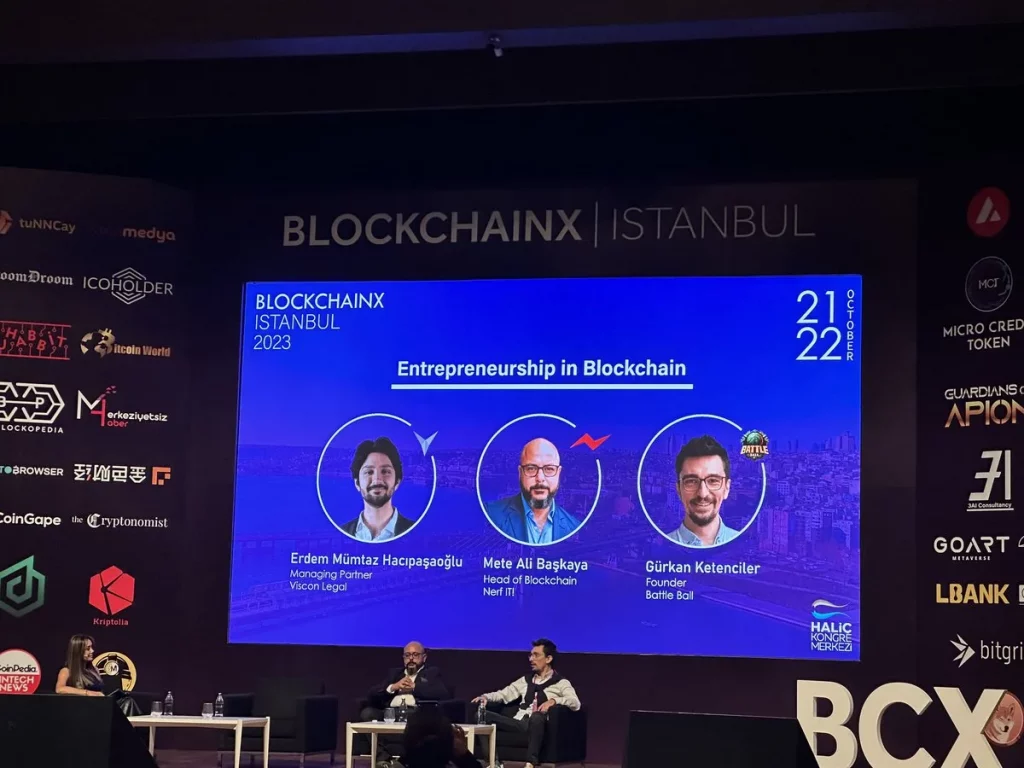
On 22 October 2023, Vircon Legal co-founder Erdem Mümtaz Hacıpaşaoğlu joined the closing panel at BlockchainX Istanbul, speaking alongside Mete Ali Başkaya and Gürkan Ketenciler on “Entrepreneurship in Blockchain.”
From protocol to company
Blockchain projects often begin as something other than a company: a repository, a Discord, a handful of contributors in different countries who have never signed anything. That works until the project has value. At that point the absence of structure stops being lightweight and becomes the main obstacle to raising, hiring or partnering — because there is no entity that can demonstrably say it owns the code.
Who owns the code
The first question in any diligence exercise is whether intellectual property has been assigned to the company. In an open-source project this is more delicate than in a conventional startup: contributions arrive from people with no contract, under licences that were chosen quickly and are rarely revisited. A permissive licence and a copyleft licence lead to very different commercial futures, and the choice is effectively irreversible once a community has built on top of it. Contributor licence agreements exist precisely so that a project can later be commercialised without asking every historical contributor for permission.
The same logic applies to founders. Code written before incorporation belongs to the person who wrote it unless it is assigned; a repository under a personal account is not company property because everyone assumed it was.
The DAO question
A decentralised autonomous organisation is a governance mechanism, not a liability shield. Where a group of people acts together for a common purpose without an incorporated vehicle, most legal systems will treat them as some form of partnership — which typically means unlimited personal liability for participants, precisely the outcome the structure was meant to avoid. Serious projects therefore pair on-chain governance with an off-chain legal wrapper, and are explicit about which decisions the wrapper can and cannot execute.
Smart contracts raise a parallel point. Automatic execution is not the same as legal enforceability: the code determines what happens, the contract determines what should have happened, and when the two diverge someone has to bear the difference. Naming that allocation in advance — including what happens after an exploit — is cheaper than litigating it.
Funding a project that has a token
Investors in this sector usually want exposure to both the equity and the network. That means a SAFE or equivalent alongside a token warrant, and it means the relationship between the company and the token issuer has to be coherent. Where the token is issued by a foundation and the code is developed by an operating company, the agreements between them, and the transfer pricing behind those agreements, are what make the structure defensible. Our comparison of the instruments is in SAFEs vs. SAFTs.
Go deeper
Author

More from Vircon Insights
Doing Business in USA: YTILI Alumni Board Panel
September 3, 2025Istanbul Bar IT Conversations Episode #3: The Crypto-Asset Bill
December 3, 2024AIPA Tomorrow Talks 75: AI and Blockchain
October 19, 2024Legal Aspects of Web3 Nowadays: DeGameFi Tbilisi Panel
August 7, 2024Web Summit Qatar 2024 Keynote: Clemta's SaaS Transformation and Blockchain Legal Infrastructure
February 29, 2024Web3 & Metaverse Panel: İstanbul (November 2023)
November 18, 2023Related Practice Areas
ICOs, Crypto & Blockchain
Crypto-asset regulation, token offerings, exchange and custody licensing.
View service →Startup Law
Incorporation, founder agreements, ESOP, term sheets, regulatory matters.
View service →Corporate Law
Share transfers, capital increases, board structuring, governance.
View service →