
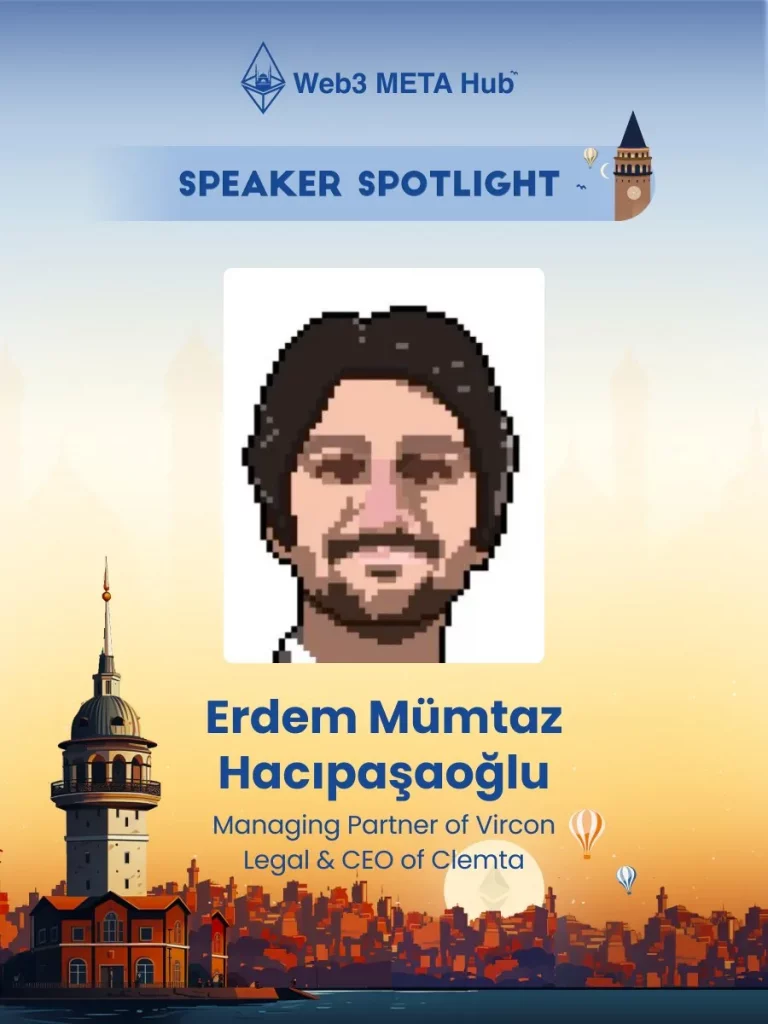
On Saturday, 18 November 2023, Vircon Legal Managing Partner Erdem Mümtaz Hacıpaşaoğlu spoke at a Web3 and Metaverse panel in İstanbul, alongside other speakers from the ecosystem.
Virtual worlds raise old legal questions in new clothes
Most “metaverse law” questions turn out to be property, contract and consumer questions that existing law already answers — but answers differently once the asset is a database entry rather than a physical thing. What a user buys when they buy virtual land, what happens to that purchase if the platform shuts down, and who is liable when an avatar causes harm are not novel legal categories. They are familiar categories applied to an object whose existence depends entirely on someone else’s server.
What is actually being sold
The commercially decisive question is whether a virtual item is sold or licensed. Platform terms almost always say licensed: the user receives a revocable, non-transferable permission to use an item, not ownership of it. That framing survives right up until the marketing promises “true ownership,” at which point the gap between the terms of service and the sales narrative becomes a consumer-protection problem rather than a drafting preference.
Tokenising the item does not by itself close that gap. An NFT records an entry on a ledger; whether it carries any right to the underlying artwork, model or parcel depends on the licence attached to it, which is a contract question and not a blockchain one. The distinction between owning the token and owning the intellectual property in what it points to is the single most common misunderstanding in this market.
Intellectual property, user-generated content and the platform’s position
Virtual worlds run on user-generated content, which puts three IP relationships in play at once: what the platform licenses to the user, what the user licenses to the platform, and what neither of them owns because it belongs to a third party. Brand infringement inside a virtual store, unlicensed reproductions of real products, and avatars using someone’s likeness are all ordinary infringement claims with an unusual venue. A platform’s exposure turns on the notice-and-takedown machinery it actually operates, not the one described in its policy page.
Payments, in-world economies and the regulated perimeter
An in-world economy stays outside financial regulation while its currency is a closed loop that cannot leave the platform. Once value can be cashed out, traded against crypto or fiat, or held for others, the operator is approaching payment, exchange and custody regimes and the anti-money laundering obligations that come with them. In Türkiye that perimeter runs through the crypto-asset service provider regime — see CASP / Crypto Compliance. Games monetised through loot boxes and randomised rewards face a separate line of scrutiny under consumer and, in several jurisdictions, gambling rules.
Personal data is the quieter risk. Immersive platforms capture movement, gaze and voice — data that is behavioural, often biometric in character, and collected from a user base that skews young. That combination attracts the strictest end of data-protection analysis; see our KVKK compliance guide.
Go deeper
Author

More from Vircon Insights
Legal Aspects of Web3 Nowadays: DeGameFi Tbilisi Panel
August 7, 2024AI Summit for Lawyers: Lokomotif AI at Vadi İstanbul
November 19, 2025Doing Business in USA: YTILI Alumni Board Panel
September 3, 2025Pioneering Startups Shaping the Future of Web3 in Türkiye: Webrazzi Fintech 2024
December 11, 20242024 Web3 Legal Trends: Qatar Websummit Workshop
June 3, 2024Panel: Entrepreneurship in Blockchain at BlockchainX Istanbul
October 22, 2023Related Practice Areas
ICOs, Crypto & Blockchain
Crypto-asset regulation, token offerings, exchange and custody licensing.
View service →Intellectual Property
Trademark, patent, copyright and trade secret advisory.
View service →Gaming & Esports Law
Studio funding rounds, chain of title, publishing and platform agreements, esports.
View service →