
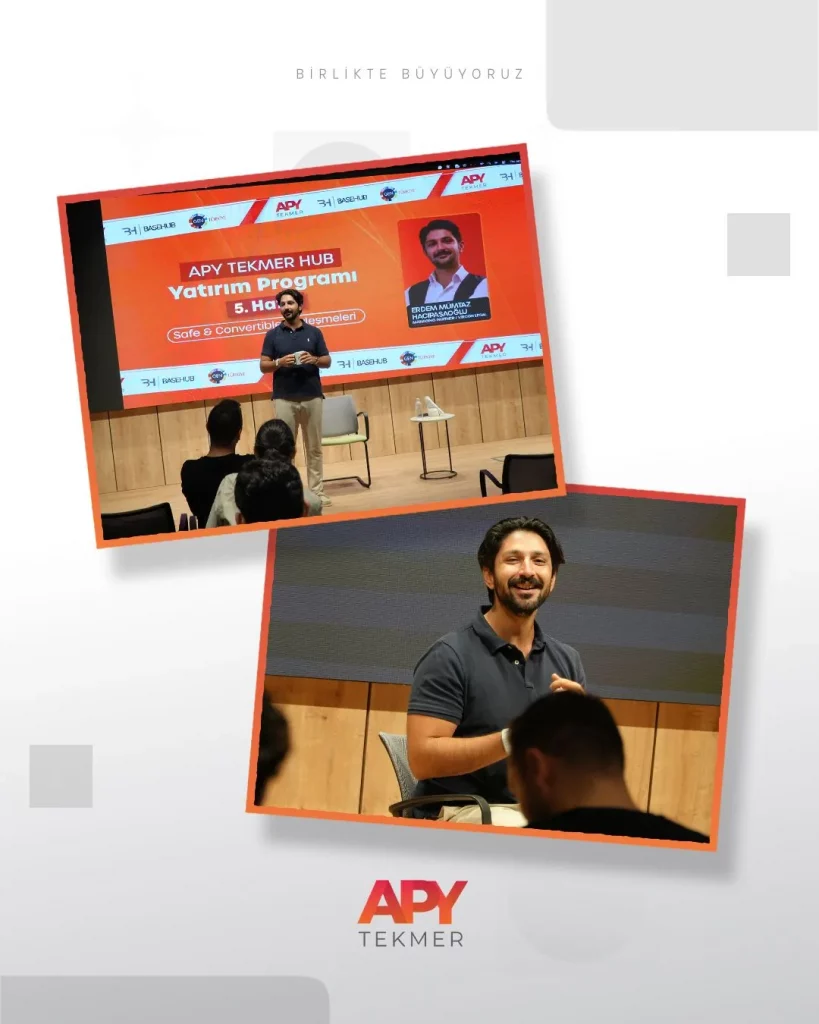
Vircon Legal Managing Partner Erdem Mümtaz Hacıpaşaoğlu joined the founder cohort at Week 5 of the APY TEKMER HUB Investment Program, run with BASEHUB and GEN Türkiye. The session covered the documents that carry most early-stage rounds to a priced financing: the SAFE and convertible instruments.
Note or loan? The distinction matters more than it looks
The session opened with a distinction the market routinely blurs: a convertible note and a convertible loan are not the same instrument. The note comes from American practice with a securities logic: standardised, and written to convert into equity from day one. The loan is, at its core, a credit agreement: maturity, interest and the repayment claim are serious, and conversion is a possibility. In Türkiye the distinction has a local edge: a structure built around a genuine repayment expectation can invite the unlicensed money-lending debate (usury, Turkish Criminal Code Art. 241). Knowing which instrument you hold is not terminological pedantry; it is risk classification.
Why Y Combinator invented its own instrument
The SAFE was born in 2013 precisely as a reaction to the note’s problems: maturity-date pressure, accruing interest, and the “is this debt or investment?” ambiguity. YC deleted maturity and interest entirely, leaving only the conversion promise, and in 2018 switched to the post-money version to simplify the maths. Standardisation’s real value is lower negotiation cost: everyone argues over the same handful of variables. Three of those variables got their own treatment in the session: the valuation cap (a ceiling on the conversion price, the investor’s dilution insurance), the discount (a haircut on the next round’s price), and the MFN clause (any better term given to a later investor flows back to the earlier one, the provision that propagates quiet side letters across the whole table).
The real Turkish-law obstacle and the 4 June 2026 legislation
Nothing stops a Turkish company from signing a SAFE as a contract; the obstacle sits at the instrument’s heart, in automatic conversion. Under the Turkish Commercial Code, conversion never happens by itself: it requires a capital increase, a general assembly and registration, and the closest native mechanism, conditional capital (TCC Arts. 463–472), is a rigid, narrow-purpose regime. The development that may change this picture is fresh: Article 11 of the omnibus law published in the Official Gazette on 4 June 2026 adds a paragraph to Law No. 5746 exempting non-public companies holding the Ministry of Industry’s Teknogirişim Badge from the TCC’s conditional-capital regime for capital increases based on convertible-debt agreements, with the procedure left to the Ministry. The gaps were discussed just as openly: the scope covers badge-holders only, the secondary regulation does not yet exist, and a clear criminal-law safe harbour (usury) is still missing. Our full analysis: Is the SAFE enforceable in Türkiye?
Is automatic conversion mandatory?
The cohort’s sharpest question got the clearest answer: no. That is exactly why the document must import the conversion mechanism rather than assume it. The Turkish structure that works stands on three legs: groundwork laid in advance in the articles of association, conversion pre-commitments collected from every shareholder, and enforcement backed by a penalty clause against the holdout.
The most common mistakes in Türkiye-style SAFEs
| Mistake | What it costs |
|---|---|
| Translating the American template and signing it without importing the conversion mechanics | On conversion day the document becomes a wish, hostage to shareholder goodwill |
| Writing the cap in USD and never discussing currency risk | A very different dilution two years later; the number-one seed of founder-investor disputes |
| No stacking rule across overlapping instruments | The priced round opens three negotiations at once |
| Leaving interest and repayment clauses in “for comfort” | Pushes the instrument toward a loan and invites the usury debate |
| Collecting pre-commitments from the founder only | The minority shareholder returns at conversion holding leverage |
Our thanks to the APY TEKMER, BASEHUB and GEN Türkiye teams for the invitation, and to the cohort for sharp questions. Event highlights are on LinkedIn.
Sources. Turkish Penal Code No. 5237. Statute links open the official consolidated Turkish texts on mevzuat.gov.tr.
Author

More from Vircon Insights
EWA Grow 2026: Legal Foundations Training for Food and Agriculture Startups
October 18, 2026Alumni Circles at the LEAD21 10th Cohort Summit: Mümtaz Among the Alumni
October 13, 2026Agentic Commerce in Türkiye: When an AI Agent Pays, Who Consented?
October 25, 2026Hybrid Work Is Now in Turkey's Remote Working Regulation: Office and Remote Days Must Be Written into the Employment Contract (Official Gazette 25.09.2026)
October 25, 2026Advertising a Game in Türkiye: The Commercial Advertising Regulation, the Influencer Guide, Children and the Word "Free"
October 25, 2026DORA, Cloud Concentration and Post-Quantum Cryptography: An Operational Resilience Map for Turkish Fintechs (2026)
October 24, 2026Related Practice Areas
US Company Formations & Flip-Ups
Delaware C-Corp, flip-up structures, SAFE/convertible notes, 83(b).
View service →Corporate Law
Share transfers, capital increases, board structuring, governance.
View service →Startup Law
Incorporation, founder agreements, ESOP, term sheets, regulatory matters.
View service →