
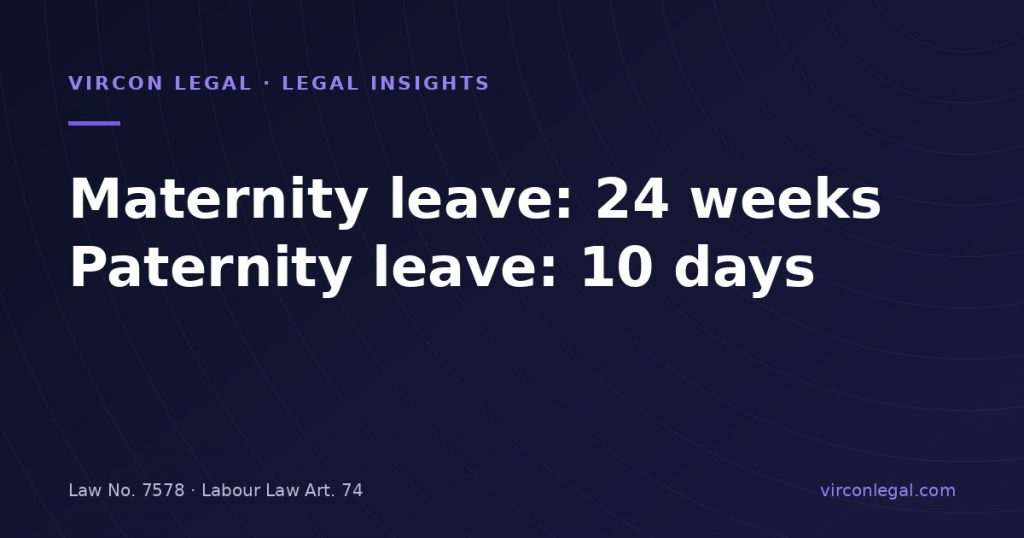
Since 1 May 2026, an employee in Türkiye who gives birth gets 24 weeks of maternity leave instead of 16, and a father 10 days of paid leave instead of 5. The changes come from Law No. 7578, published in the Official Gazette of 1 May 2026 (No. 33240) and in force the same day. The Social Security Institution (SGK) maternity benefit was extended to match. For a startup or foreign company with a Turkish team, that means planning for an absence of roughly six months and updating contracts, handbooks and payroll that still show the old numbers.
What Law 7578 changed
Law 7578 is an omnibus law. Its leave provisions amend the Labour Law No. 4857, the Social Insurance Law No. 5510 and, for public sector staff, Civil Servants Law No. 657 and the personnel laws of the armed forces, Gendarmerie and Coast Guard. For private employers:
| Topic | Before 1 May 2026 | Now | Provision |
|---|---|---|---|
| Maternity leave | 16 weeks (8 before, 8 after birth) | 24 weeks (8 before, 16 after birth) | Labour Law Art. 74(1) |
| Multiple pregnancy | 2 extra weeks before birth (18 in total) | 2 extra weeks before birth (26 in total) | Art. 74(1) and (6) |
| Working closer to the due date (doctor’s approval) | Until 3 weeks before birth | Until 2 weeks before birth | Art. 74(1) |
| Paternity leave | 5 days paid | 10 days paid | Additional Art. 2 |
| Foster parents | No specific leave | 10 days unpaid, on request | Art. 74(1) |
| Optional unpaid leave | Up to 6 months after the 16 (18) weeks | Up to 6 months after the 24 (26) weeks | Art. 74(6) |
| SGK maternity benefit | 8 weeks before, 8 after birth | 8 weeks before, 16 after birth | Law 5510 Art. 18(1)(c) |
Maternity leave under Article 74, as now worded
The basic rule is that a female employee is not to be employed for 8 weeks before and 16 weeks after birth, 24 weeks in total. In a multiple pregnancy, 2 weeks are added to the pre-birth period. If her health allows and a doctor approves, she may choose to keep working until 2 weeks before the birth (previously 3), and the weeks she works are added to the post-birth period. If the baby arrives early, the pre-birth time she could not use is added after the birth. If the mother dies at or after the birth, the unused post-birth time passes to the father.
Unchanged but worth remembering: the periods can be extended on a physician’s report; a pregnant employee gets paid leave for periodic check-ups and, on a physician’s report, lighter work without a pay cut. Adoption leave for private sector employees was not changed: one adopting spouse, or a single adopter, of a child under three still gets 8 weeks from actual placement. And Article 74 applies to every employee under an employment contract, whether or not the workplace falls within the Labour Law’s scope.
Paternity leave: ten days, paid by the employer
Additional Article 2 of the Labour Law now gives an employee 10 days of paid leave when his spouse gives birth. This is employer-paid leave (“ücretli izin”): Law 5510 Article 18 provides the maternity benefit only for the insured woman, so the father’s 10 days stay on your payroll as normal salary. The other excuse leaves in the same article did not change: 3 days of paid leave for the employee’s marriage, for adopting a child, or for the death of a parent, spouse, sibling or child, and up to 10 days of paid leave a year for the treatment of a child with at least 70% disability or a chronic illness (one parent only, on a medical report).
Law 7578 also added a new sentence to Article 74: an employee who becomes a foster parent to one or more children, alone or with a spouse, gets 10 days of unpaid leave on request after the child is placed.
Who pays during maternity leave
The employer does not pay salary for the 24 weeks unless it has agreed to: under Labour Law Article 25, wages do not accrue while the contract is suspended. During that time, SGK pays a temporary incapacity benefit (geçici iş göremezlik ödeneği) under Law 5510 Article 18(1)(c). Law 7578 changed that provision so the benefit now covers each day not worked in the 8 weeks before and 16 weeks after birth, with 2 extra pre-birth weeks for a multiple pregnancy.
For HR and payroll:
- Eligibility. At least 90 days of short-term insurance premiums must have been reported in the year before the birth.
- Amount. The benefit is two-thirds of the employee’s daily earnings for outpatient periods (half for inpatient periods), with daily earnings calculated under Article 17 from the 12 months before the birth. It is not full salary, so the gap is the employee’s unless your contract, policy or collective agreement promises a top-up.
- Process. According to SGK, maternity reports issued electronically by health providers go to SGK’s database and to the employer’s “not worked” notification screen (çalışılmadığına dair bildirim) in the e-SGK system, and SGK pays the benefit through contracted banks. SGK also states that no benefit is paid for days an employee works during a rest report without a doctor’s report confirming she can work.
- Founders. SGK states that women registered as company partners (şirket ortağı) do not receive the maternity incapacity benefit. A co-founder insured as a company partner rather than as an employee should not count on it.
After the 24 weeks: what an employee can still ask for
The longer leave moves the start of the follow-on rights:
- Half-time unpaid leave (Art. 74(2)). After the post-birth leave, the mother (or an adoptive parent of a child under three) may work half of the weekly hours, unpaid for the other half: 60 days for the first birth, 120 for the second, 180 for later births, plus 30 days on each of these in a multiple birth, and 360 days if the child is born with a disability. Nursing leave does not apply during this period.
- Up to six months’ unpaid leave (Art. 74(6)). Available on request after the 24 weeks (26 in a multiple pregnancy), also to one adoptive spouse, or a single adopter, of a child under three. It does not count toward annual leave entitlement.
- Nursing leave (Art. 74(7)). One and a half hours a day for a child under one. The employee decides when and how to split it, and it counts as working time.
- Part-time work (Art. 13). After the Article 74 leaves end, one parent may ask to work part-time until the start of the month after the child reaches compulsory school age. The employer must accept, with at least one month’s written notice from the employee.
If the return involves a remote or hybrid set-up, the contract changes overlap with the points in our hybrid working article.
Entry into force and employees already on leave
Under Article 27 of Law 7578, the leave provisions entered into force on publication, 1 May 2026; only Articles 22 and 23, which concern internet law, were deferred by six months. Provisional Article 1 covered staff whose maternity leave had already ended on entry into force: if, as of 1 April 2026, 24 weeks had not yet passed since the birth, they could request 8 additional weeks of maternity leave within 10 business days of entry into force. That window closed in May 2026. On the SGK side, Circular 2026/13 of 8 May 2026 is reported to extend post-birth reports still running on 1 May 2026 by 56 days without an application, and to pay benefit for up to 8 weeks to eligible employees whose reports had ended earlier and who took the additional leave. If you had a birth in spring 2026, check that payroll absence days and SGK records match.
Dismissal protection and equal treatment
Article 5 of the Labour Law prohibits different treatment because of sex or pregnancy in hiring, setting terms, applying the contract and ending it, unless biological reasons or the nature of the job require it. Where job security applies (workplaces with 30 or more employees, and at least six months’ seniority), Article 18 lists pregnancy, birth, family obligations and absence during the Article 74 periods among the reasons that are never valid grounds for dismissal. Under Article 25(I)(b), the right to terminate without notice for birth or pregnancy arises only once the absence exceeds the notice period by six weeks, counted from the end of the Article 74 period. Under Article 55, the days a woman is not employed before and after birth under Article 74 count as worked for annual leave entitlement. Article 104 sets an administrative fine for employing a woman in breach of Article 74 or refusing the unpaid leave. For the other end of the relationship, see our note on non-compete clauses for departing employees.
Where to start
- Search contract templates, offer letters and the handbook for “16 weeks”, “5 days” and “3 weeks before birth”; update them or refer to the statute.
- Split the leave policy into maternity (SGK benefit), paternity (10 days employer-paid), adoption (8 weeks, plus 3 days’ excuse leave) and foster care (10 days unpaid).
- Decide, in writing, whether you top up the SGK benefit. If you do, say for how long and on what basis.
- Make sure whoever runs your e-SGK employer account (often an outsourced payroll provider) watches the “not worked” screen during the leave.
- Plan cover for 24 weeks (26 for twins), plus possible half-time, unpaid or part-time requests afterwards.
- Brief managers: decisions on reviews, bonuses or restructuring around a pregnancy or leave must rest on other grounds.
Does the employer have to pay salary during the 24 weeks of maternity leave?
Not under the Labour Law. Wages do not accrue while the contract is suspended, and SGK pays a temporary incapacity benefit for the 8 weeks before and 16 weeks after birth, provided at least 90 days of premiums were reported in the year before the birth. An employer pays more only if a contract, internal policy or collective agreement says so.
Is the 10-day paternity leave paid by SGK or by the employer?
By the employer. Additional Article 2 of the Labour Law describes it as paid leave (ücretli izin) when the employee’s spouse gives birth, and the SGK maternity benefit in Law 5510 Article 18 is for the insured woman. Adopting a child also gives 3 days of paid excuse leave (separate from the 8-week adoption leave in Article 74), and becoming a foster parent gives 10 days of unpaid leave.
Do these rules apply to a small startup with only a few employees?
Yes. Article 74 applies to every employee with an employment contract, whether or not the workplace is within the Labour Law’s scope, and the paternity leave in Additional Article 2 has no headcount threshold. Headcount matters for job security under Article 18 (30 or more employees), not for the Article 5 ban on pregnancy discrimination.
For a broader view of our work in this area, see our employment law practice.
Sources. Law No. 7578 amending the Social Services Law and Certain Laws (Official Gazette 1 May 2026, No. 33240), Arts. 2, 15, 16, 18, 19, 24, 27 and Provisional Art. 1; Labour Law No. 4857, Arts. 5, 13, 18, 25, 55, 74, 104 and Additional Art. 2; Social Insurance and General Health Insurance Law No. 5510, Arts. 15, 17, 18; SGK, Analık Halinde Geçici İş Göremezlik Ödeneği Ödenmesi and Analık Hali; SGK Circular 2026/13 (8 May 2026), as reported (official text not publicly accessible at the time of writing).
This article is general information and not legal advice; a specific situation should be assessed with counsel.
Author

More from Vircon Insights
Türkiye Bans Social Media for Under-15s from 1 November 2026: What Platforms Must Change (Law 7578)
October 12, 2026Your First Ten Employees in Türkiye: The Employment Law Set-Up a Startup Needs Before the Second Hire
October 14, 2026Technopark and R&D Centre Incentives for a Turkish Startup: Law 4691, Law 5746 and the Three Per Cent Venture Obligation
October 13, 2026The EU AI Act in Turkish Law: A Concordance of Terms and Obligations for Providers and Deployers
October 11, 2026The Turkish Equivalent Of…: A US–Türkiye Corporate Law Concordance for Founders, Investors and Counsel
October 9, 2026MASAK Thresholds Doubled from 7 October 2026: AML Obligations for Payment, E-Money and Crypto Firms in Türkiye
October 8, 2026Related Practice Areas
Employment Law
Employment contracts, ESOP, termination, non-compete, work permits.
View service →Startup Law
Incorporation, founder agreements, ESOP, term sheets, regulatory matters.
View service →US Company Formations & Flip-Ups
Delaware C-Corp, flip-up structures, SAFE/convertible notes, 83(b).
View service →