
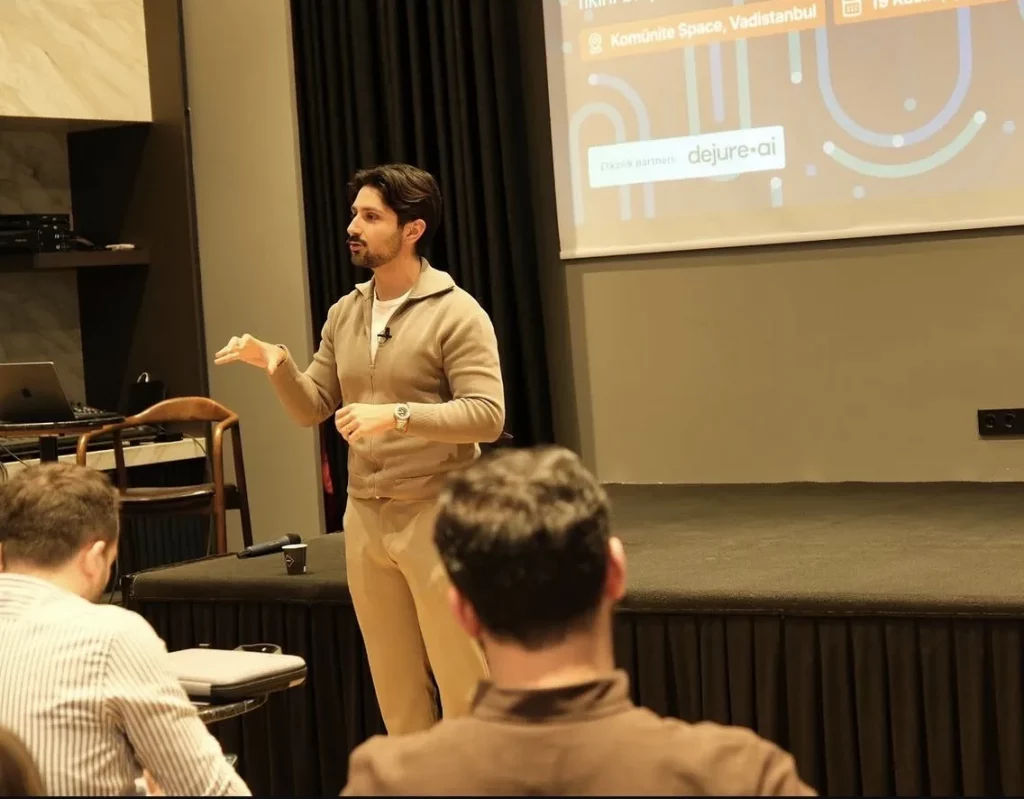
On November 19, 2025, our Managing Partner Erdem Mümtaz Hacıpaşaoğlu joined the AI Summit for Lawyers, organized by Lokomotif AI at Vadi İstanbul. The summit brought together practising lawyers, in-house counsel, law school faculty and legal-tech operators around the same question: what does it actually mean to practise law in an AI-augmented profession?
The central thesis of the summit was clear: AI is not a tool to be evaluated once and then either adopted or rejected: it is a substrate that is rapidly becoming part of how legal work is produced, and the lawyers and firms that integrate it consciously will outpace those who treat it as someone else’s problem.
The legal AI stack today
Mümtaz walked through the working layers of the legal AI stack: retrieval-augmented research, contract drafting and review, due diligence acceleration, e-discovery pattern detection, intake automation, and an emerging class of internal workflow agents that pull together documents, calendars and case data. The point was not to recite a vendor map but to make clear which layers are already production-grade and which are still experimental.
From productivity to practice redesign
The next part of the conversation moved past the productivity framing: the deeper question is not how to make a lawyer 20% faster, but how to redesign the practice so that the lawyer’s time is spent on the work that humans still do better: judgment, negotiation, client relationship, and structural design.
The new lawyer profile
Mümtaz returned to a theme he carries to many venues: the modern lawyer is no longer just a defender of precedent but a designer of structure, and that posture is even more decisive in an AI-augmented practice, where the lawyer who only knows how to push paper around will see their daily output absorbed into automated systems within a few years.
Closing message
The session closed on a practical message to the audience: the lawyers who will define the next decade are the ones treating AI not as an existential threat but as the next layer of their craft, and that orientation starts not with a single tool purchase but with a working theory of which parts of the practice are worth automating, which parts are worth keeping human, and which parts genuinely need to be reinvented.
Author

More from Vircon Insights
Lokomotif AI: AI Summit for HR Professionals
October 14, 2025Lawyers' Summit (Türkiye HOB) Livestream
April 3, 2021AI Summit for HR Professionals: Komünite (March 2025)
March 11, 2025Boğaziçi E-Founder Summit: Legal Architecture for the Next Generation of Founders
February 15, 2025Generative AI Summit for HR Professionals: Komünite
January 13, 2025Generative AI Micro Summit: Building Compliant AI
June 8, 2024Related Practice Areas
Mergers & Acquisitions
End-to-end M&A: due diligence, structuring, documentation, negotiation.
View service →ICOs, Crypto & Blockchain
Crypto-asset regulation, token offerings, exchange and custody licensing.
View service →US Company Formations & Flip-Ups
Delaware C-Corp, flip-up structures, SAFE/convertible notes, 83(b).
View service →